Chaplain’s Corner – Trenches

One day last week as I was coming in to work, I passed a Life Coach in a deep conversation with a program participant. I sensed that there was a deep and important issue being discussed, and by their demeanor the subject was more in the lines of a struggle rather than a mountaintop experience. I went into my office and began to pray for them. I then remembered a matter that came before our Elder Board at my church the night before and how deeply troubling this is for all the families and church leadership involved, and I prayed. I thought about a situation I encountered at the Women’s Campus just the day before where the case managers are dealing with a mentally ill woman, attempting to balance her safety and desires with the needs of the entire campus (and how many times this is done daily on both campuses). I then thought of and prayed for several of our employees who were or are in the hospital and dealing with serious medical issues for themselves or a family member. I prayed for a dear family friend who has been diagnosed with advanced pancreatic cancer. I thought of so many who have lost loved ones, from parents to cousins to children and prayed for them in their grief and heartbreak.

As I prayed, I realized that this is what Oswald Chambers meant in the My Utmost for His Highest October 2 reading:

 “After every time of exaltation, we are brought down with a sudden rush into things as they really are, where it is neither beautiful, poetic, nor thrilling. The height of the mountaintop is measured by the dismal drudgery of the valley, but it is in the valley that we have to live for the glory of God. We see His glory on the mountain, but we never live for His glory there. It is in the place of humiliation that we find our true worth to God— that is where our faithfulness is revealed.”

I had originally labeled this Chaplain’s Corner “Valleys” because of Chambers’ reference to valleys, but that brings to mind rivers and trees and green lush land. I realized that the better label would be “Trenches” because that brings to mind warfare. These situations are where the battlefield of God and Satan play out, and where we are called to walk together faithfully during the everyday battles.

I’m thankful that Jesus is our King of Kings and Lord of Lords. I’m thankful for the Holy Spirit who resides within us, and all we have to do is call out to him. I’m thankful for my church family, and I’m so very thankful for each of you. We are blessed to work in a place where we can corporately and individually call upon Jesus anytime, where we can stop and pray for each other anytime. This is a definitely a place where we get to see transformation and mountaintops, but it’s even more a place where we fight it out together in the trenches every day. Jesus said it wouldn’t be easy, and if there is anywhere I want to be living out life together in the trenches, it is here with each of you. May God bless you.

“Even though I walk through the darkest valley, I will fear no evil, for you are with me; your rod and your staff, they comfort me” (Psalms 23:4 NIV).

 “But encourage one another daily, as long as it is called ‘Today,’ so that none of you may be hardened by sin’s deceitfulness” (Hebrews 3:13 NIV).


Cry Out to Jesus (Third Day)


To everyone who’s lost someone they love

Long before it was their time

You feel like the days you had were not enough

When you said goodbye


And to all of the people with burdens and pains

Keeping you back from your life

You believe that there’s nothing and there is no one

Who can make it right


For the marriage that’s struggling just to hang on

They’ve lost all of their faith in love

And they’ve done all they can to make it right again, still it’s not enough


For the ones who can’t break the addictions and chains

You try to give up but you come back again

Just remember that you’re not alone in your shame

And your suffering


When you’re lonely

And it feels like the whole world is falling on you

You just reach out, you just cry out to Jesus

Cry to Jesus


To the widow who suffers from being alone

Wiping the tears from her eyes

And for the children around the world without a home

Say a prayer tonight


There is hope for the helpless

Rest for the weary

And love for the broken heart

And there is grace and forgiveness

Mercy and healing

He’ll meet you wherever you are

Cry out to Jesus.
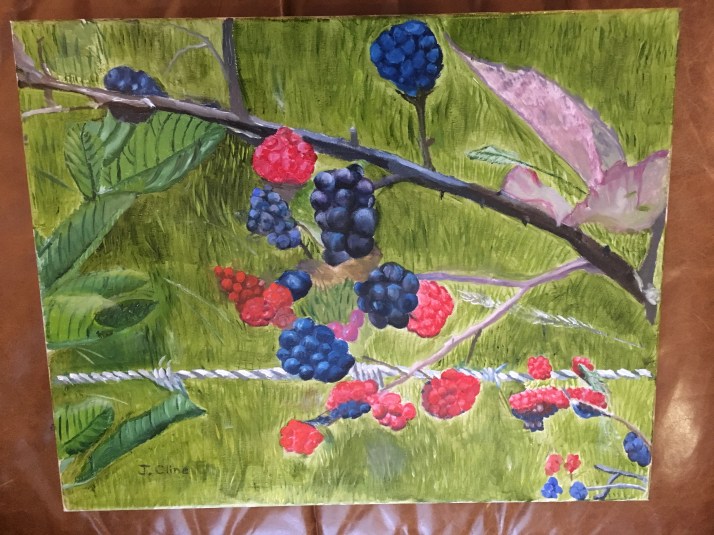
Painting

I can’t draw stick people. My least favorite game is Pictionary. I’m an utter failure at it. My daughter in law is a talented artist. My husband and both sons can draw, and of course all my grands are wonderfully gifted. But I’ve never had any hope of ever being able to draw. So when a friend invited me to take painting classes with her I said “Sure, why not?,” thinking this would prove for all time that I have no artistic talent.

I started taking lessons from David Gillihan on this past August. I’m now a member of the Artists on Main Painting Society. Here are my first two paintings:

Ok, I’ve had help from David. But I’m not hopeless, anymore. David is sure he can teach me and I’m excited to learn. More to follow.

Chaplain’s Corner – Cleaning

My husband thinks I am a little crazy, but I really like to clean. Not just the regular dusting and sweeping kind of cleaning, but the kind of cleaning where you take everything out of the cabinet, scrub it, reorganize, polish. Usually, I get in a hurry and pile things around, so every once in a while this deep cleaning, as I call it, is necessary. Probably the worst place for getting in bad shape is my refrigerator. My pet peeve is too many open bottles of condiments.  How many jars of mustard does one family need, anyway? I must confess that over the weekend I pulled out 87 VHS tapes to figure out what to do with, since we haven’t played any of them in at least 10 years. That’s a lot of space to put to better use, for sure! So I do enjoy returning my home to its intended functionality and purpose.

This is a metaphor for our lives, isn’t it? Our lives can get cluttered with the unnecessary, whether it be more physical stuff than we need; or emotional habits, problems, and feelings; or time-wasting endeavors, etc. — all things that can distract us from our intended functionality and purpose. Sometimes what we need is a deep cleaning for our own lives.

I thought about this as I was reading in the gospels about John the Baptist. In each of the four gospels, John the Baptist says that he came to baptize the Jews with water for repentance. In Luke 3, he clarifies by saying that “the man with two tunics should share with him who has none, and the one who has food should do the same.” He told the tax collectors “don’t collect any more than you are required to” and he told the soldiers “don’t extort money and don’t accuse people falsely–be content with your pay.”

 The September 29 “Daily Hope” devotional by Rick Warren really challenged me in this regard. He talked about the necessity of confession in order to purify our lives. He recommended this practice:

“Here’s what I suggest you do if you really want to be used by God: Take time this week to sit down with a pen and a pad of paper, and say, “God, what’s wrong in my life? Show me. I’m going to write it down, and I’m going to admit it. I’m going to confess it to you.” Then, when God gives you an idea, write it down…. Make a list, and then write 1 John 1:9 over it and say, “God, I admit these to you. These are wrong. I don’t want them in my life.” Ask God to cleanse your life. God will forgive you!”

 Rick said that you don’t have to be a perfect person, but you do have to have a pure heart.  He quoted 2 Timothy 2:21, “If you keep yourself pure, you will be a special utensil for honorable use. Your life will be clean, and you will be ready for the Master to use you for every good work” (NLT).

 “If we confess our sins, he is faithful and just and will forgive us our sins and purify us from all unrighteousness.” 1 John 1:9

When John the Baptist was preaching repentance, he was preparing the way for Jesus to come and to baptize us all with the Holy Spirit. Augustine said, “The confession of bad works is the beginning of good works.”  I pray that we will all commit to a regular practice of confession and repentance so that we can be used by Jesus in the way that he intended, in a way that will most glorify Him.

Blessings,

Judy

Chaplain’s Corner – Books

I love books. I love to read, and of course, books are one of the main ways to accomplish reading. I know there are also other objects to read such as magazines, newspapers, letters, emails, cereal boxes, close-captioned television (kidding—just wanting to see if you are paying attention!). But I particularly love books. I am a long time member of the library and regularly check out books. My first library was the East Nashville library, and that is still my standard for a library.

I also like to own books. I used to be selfish about my books; however, I was convicted of that by a quote from C.S. Lewis: “But you will find that your library in Heaven contains only some of the books you had on earth.” ‘Which?’ I asked. ‘The ones you gave away or lent.’”  So now, I will loan and give away my books, and cherish the impact that my books might have on the recipient. For example, I have bought and loaned the book Redeeming Love by Francine Rivers (one of my favorite authors) countless times. I do not currently own a copy but need to pick one up, just in case you might want to borrow it! I look forward to having a well-established library in heaven.

Once I had to complete a questionnaire for a newspaper article that included the question: “If you were stranded on a desert island, what is the one book you would most want to have with you?” Well, I think you know me enough to know that my answer was the Bible. I have written many of these Chaplain Corner articles about how God’s Word as revealed in the Bible is essential to daily life. However, if we are talking about books, there is a book that is more important than the Bible and that is the Book of Life. When the apostle John was in exile on Patmos, Jesus instructed him to write letters to the seven churches. In one of the letters he writes “The one who is victorious will, like them, be dressed in white. I will never blot out the name of that person from the book of life, but will acknowledge that name before my Father and his angels.” (Revelation 3:5.)

 Other books are also referenced in the Bible, specifically in the book of Revelation, chapter 20:  12And I saw the dead, great and small, standing before the throne, and books were opened. Another book was opened, which is the book of life. The dead were judged according to what they had done as recorded in the books.15Anyone whose name was not found written in the book of life was thrown into the lake of fire.

 To sum up: Our life stories are being written and all our deeds are being recorded in the books. At the judgment seat of Christ, Jesus will open the books of all who are not also recorded in the Book of Life. We know that our deeds no matter how great cannot save us, and no matter how vile cannot condemn us. After passing judgment, those whose names are not also in the Book of Life, regardless of their deeds, will be doomed to eternity in hell.

The only way to avoid being judged by our deeds (a very frightening thought for anyone) is to also have our names written in the Lamb’s Book of Life, which occurs when we accept Christ as our Savior. When our names are written in the Lamb’s Book of Life, we are accountable only for what Christ has done in us, and that means that we are victorious and will reign forever with Him. I pray that all our names will be written in the Book of Life, and that we will all reign victoriously with Jesus, a happy ending beginning for sure.

Blessings,

Judy

Chaplain’s Corner – Forgiveness

I have very recently been impacted by the sinful actions of someone close to me. (In case you wonder, this has nothing to do with anyone here at the Mission.) I know that the sinful action was not intentionally directed at me, but it did affect me with potentially deep repercussions.

The person who sinned asked me for forgiveness, and I freely gave it because I know that is the right thing to do. I will not hold this action against this person. I have experienced far too much grace in my life to withhold it from others. However, I have spent quite a bit of time pondering over my response, because even though I have forgiven, I can’t forget, nor do I believe I should.

First of all, forgiving does not mean condoning. I have already been clear with the person about that. I’ve talked through the circumstances that caused the sin to occur and how to avoid it in the future. Because this person is a dear friend and fellow believer, it is my responsibility to hold them accountable for actions that lead to sin. I will do that lovingly, and I’m grateful for a relationship that will allow us to do that.

Second, forgiving does not mean that there are no consequences. In this case, that is mostly beyond my scope anyway. Consequences will be forthcoming. Where I believe my responsibility lies is in not allowing this person to feel they are the victim of the consequences or that they somehow are being wronged when the consequences result. That is the human response, but would negate the healing and reinforcing effect of those consequences. This is difficult. Because I care for this person, I prefer to commiserate with them, but that would not be helpful; however, under no circumstances do I want to appear unloving. So I must remain prayerful about how I deal with this.

Third, and perhaps most importantly for me, I can’t assume that I have no guilt in this situation, even though to all I appear as a totally innocent party. In fact, on Saturday during my prayer time I had spent special time asking God to convict me of my sins—to open my eyes to where I need to change. Then on Sunday my pastor preached about complacency which I believed to be God answering my prayer, and then Monday I find out about the incident. I believe that in all this, God is also answering my prayer for conviction and discernment. We all sin. Some of us get caught and are forced to deal publicly with the sin. Others of us seem to escape those consequences. That doesn’t mean that we should be “off the hook.”

Search me, God, and know my heart; test me and know my anxious thoughts. See if there is any offensive way in me, and lead me in the way everlasting. Psalm 139:23-24 (NIV)

So this is a complicated situation. It is still fairly fresh. I am trying to learn from it and to allow God to work through me. I do trust that “…in all things God works for the good of those who love him, who have been called according to His purpose” (Romans 8:28).Although this is very personal, I pray that it will be helpful for you. I welcome your thoughts and prayers.

Blessings,

Judy

Chaplain’s Corner – Power

This weekend I had a glitch. I picked up my cell phone to follow up on a meeting arrangement, and the phone was not charged. This was a problem because I don’t have a landline anymore. I had put it on the charger, so what was wrong? I have a pretty nice smart phone with lots of features and apps; however, it was useless even for the most basic of functions—making a call! Do you know the feeling? The problem was that I had failed to plug the charger itself into the wall outlet. Guess what, no connection to the source of electricity to power the charger to make my phone work.

I attended a leadership function years ago during which Nelson Andrews gave a speech.  What I remember from his speech is that power (money, influence, authority) is not power unless it is used.  He was referring to civic leadership; however, the analogy is appropriate for this case.  The wall outlet was full of power, but nothing was plugged into it. Therefore, it was not being used to serve its purpose.

By the way, plugging the charger into the wall outlet does no good if the electricity is down.  This actually presented another problem for me during a recent thunderstorm when our power went off.  Let’s not forget that for our spiritual health, we have an ultimate power source that never shuts down, no matter how severe the storm.  Hallelujah!

I’ve always loved this passage from Psalm 20:5-7(NIV) because it points us to our ultimate source of power:

5 May we shout for joy over your victory
and lift up our banners in the name of our God.

May the Lord grant all your requests. 6 Now this I know:
The Lord gives victory to his anointed.

He answers him from his heavenly sanctuary
with the victorious power of his right hand.

7 Some trust in chariots and some in horses,
but we trust in the name of the Lord our God.

As I write this, I am remembering September 11 seventeen years ago. It was horrifying, not knowing what might happen next. We all felt that we were under attack (and we were and we are), and we might have felt powerless. However, in every situation that we face—whether personal crises, corporate challenges, or governmental failures—our LORD has already won the victory. We don’t have to be powerless. As the psalmist says in the passage above, “The LORD gives victory to his anointed.”  I pray that you will plug in to your ultimate power source by praying, reading your Bible, and participating in a local church for corporate worship, fellowship, and accountability. We have power through Christ our LORD.  Plug in.

Blessings,

Judy

Chaplain’s Corner – Role Model

I’m sometimes asked about role models. For me, the first person who comes to mind is my mother’s mother, my Grandmother. She died in 1992 after many years of being very sick. In fact, I would say that her ability to really relate to anyone ceased while I was in my early twenties; however, her life still influences me to this day.

Grandmother was a good cook and kept a clean house. She didn’t drive. I don’t remember that she had any hobbies other than embroidering and crocheting. She was even-tempered, and I can remember her laughing but I don’t remember her ever raising her voice. When my grandfather became terminally ill in his 40’s, she went to work as a nurse’s aide at the old Baptist Hospital until her back gave out in her 60’s from changing too many beds and bedpans.

She was my role model because she always put her family first, and she showed her love by caring for each of us. In turn, each of her five children lived with her at some time during their married lives. My family lived with her upon our return from my Dad’s tour of duty in Alaska, until I was three years old. I have vague but good memories of that time. My youngest uncle still lived at home and it was a busy, happy, crowded place. It was tradition to have Christmas Eve at her house, and we had picnics often in her back yard. I loved sitting with her at church.

I spent many nights, weekends, and weeks at her house; in fact, she would use her vacation allowing me and my cousins to stay with her. I can remember leaving her house in a taxi with my mom as Grandmother waited for the bus to take her to work, after I had just spent a week with her. I didn’t appreciate it then, but now I can’t believe she didn’t take some time for herself. She didn’t have to keep us, but she wanted to spend time with us, and I think she probably also wanted to give her children a break by spending her well-earned vacation time on us.

I have to mention here that I was probably not always the most lovable child. My grandchildren can sometimes be a handful, somewhat selfish and sometimes wanting their way at the expense of others. As I observe them, I recall things that I used to do or say as a child and realize that they aren’t too different from me. (That hurts to admit!)

Grandmother and I had a great relationship. I was her favorite (and I’m quite sure that each of her children and grandchildren also thought that they were her favorite. That’s okay; it was (almost) never a competition. She modeled love and we learned firsthand from her what it meant to love. Hers was a godly, selfless love. I loved her so.

When asked the greatest command in the law, Jesus responded by quoting from Deuteronomy 6:4-7: “Love the Lord your God with all your heart and with all your soul and with all your mind and with all your strength.” (Mark 12:30)

I don’t know about you, but sometimes I wonder if I really love God like I’m supposed to, like this passage instructs. As I ponder this, I realize that my love for Him stems most from my gratitude for what He has done for me, for how he has loved me unconditionally, even when I was unlovable, enough to sacrifice his own precious Son on the cross to pay for my sins and ensure that I would not have to spend eternity in hell but instead in Paradise with Him.

When I think of my Grandmother, her sacrificial love for me always comes to mind and I can’t help but love her for it. When I think of my LORD and his sacrificial love for me, I can’t help but love Him for it. I pray the same for you.

I also pray for you that you have someone you can pour your life into, someone for whom you can model sacrificial, unconditional love so that they can relate to the love of God themselves. I think this is what Jesus had in mind when he added the second greatest command: “The second is this:  Love your neighbor as yourself.”  (Mark 12:31)

Blessings,

Judy

Chaplain’s Corner – Tools

Tools of the trade—everyone has them.  Our Maintenance Team has lots of different tools because they do so many kinds of work, from electrical and plumbing to construction and painting.  The same can be said for our Kitchen Staff. They have tools and equipment to prep raw food and then to fry, bake, and boil foods according to the recipe to produce delicious and healthy meals. Guest Services, Case Managers, Life Coaches, the Finance, Development, and Human Resource Teams—all have specific tools from computer programs to resource materials to help them to safely and correctly perform their jobs. And we have tools at home—washing machines, lawn mowers, etc. Tools make our lives easier.  Tools help us to do a better job, produce a better product. In fact, if you don’t use the appropriate tool correctly, you can damage what you are attempting to fix, and possibly hurt yourself. For example, once (maybe more than once) I tried to use my shoe as a hammer to hang a picture, and ended up tearing my shoe. It would have been much better in the long run to have used the correct tool the first time!!

Tools are so important that the development of tools is included in our history lessons. The discovery of how to use a wheel was huge in mankind’s progress. As early as in the book of Genesis we learn about Tubal-Cain, the forger of all implements of bronze and iron. There are references to the plow, the axe, the hammer, and the saw in both the Old and New Testaments. In fact, Jesus was trained as a carpenter like his father, so we can safely assume that he used carpentry tools.

Hebrews 4:12 (NIV) speaks of the Bible itself as a tool as follows: “For the word of God is alive and active. Sharper than any double-edged sword, it penetrates even to dividing soul and spirit, joints and marrow; it judges the thoughts and attitudes of the heart.” I also like how The Message translates this passage (Hebrew 4:12-13):  “God means what he says. What he says goes. His powerful Word is sharp as a surgeon’s scalpel, cutting through everything, whether doubt or defense, laying us open to listen and obey. Nothing and no one is impervious to God’s Word. We can’t get away from it—no matter what.”

And we know that “All Scripture is God-breathed and is useful for teaching, rebuking, correcting and training in righteousness, so that the servant of God may be thoroughly equipped for every good work” (2 Timothy 3:16-17). In these passages we see that the Bible acts as a tool to point us to Christ.  It convicts us of our sin and teaches us the right way to live before God.  Sure, you could substitute another “tool” for these purposes, but the result would not be as effective. In fact, it could be hazardous to your health.  This doesn’t mean that other tools might not be helpful in performing certain tasks, but the Bible is the most essential, life-giving tool we can use for living a godly life.

Most of us would not think twice about the necessity of using the correct tools of our trade. So why is it that we are so prone to turn to other sources for guidance—the television, internet, secular books and teachers, other people, our own hearts? Some of these tools may be acceptable for some purposes, but not for our spiritual health. As we seek to follow Christ, grow as disciples, and serve according to the gifts He has given us, let us be the best we can be by using all the tools available to us, most especially the Bible. I encourage you to not only read your Bible but also to study it, memorize it, and thoroughly absorb God’s Word into your very being.

Blessings,

Judy

Chaplain’s Corner – The Real Thing

I had a very nice traditional church wedding, very much like all the couples I knew had back in the 70’s, with a reception in the church fellowship hall.  Once my husband-to-be and I had set the date, I set my course on wedding-planner mode and I was absorbed in every detail of my wedding day—the invitations, the flowers, the dress, the bridesmaids, the wedding cake, etc.  Amy Vanderbilt and I became best friends as I sought her advice on every detail to ensure that it was done “just-so.”  I paid for most of the wedding myself, so I also worked on getting good deals or doing things myself.  I even made my own wedding dress (twice, because I didn’t like the first one I made), my mother’s dress, and the flower girl’s dress. The day of the wedding, I set up the fellowship hall and then cleaned the room where the bridesmaids and I would be making our final preparations.  Whew, was I ever tired!

The hour finally arrived.  I received the signal that it was time to come to the back of the sanctuary.  The bridesmaids began their procession. I met my dad, we exchanged a kiss, and we stepped up begin the walk down the aisle.  As I saw my husband-to-be waiting for me down at the altar, I almost freaked out. The thought came into my head:  “This is more than a wedding; I’m getting married! I had been working so hard on the ceremony for the past several months I had failed to realize that I was really preparing for marriage, not just a 30-minute ceremony.

That was 45 years ago last Friday, and as I pondered our marriage, these thoughts came into my mind.

  1. I had fallen in love with the idea of marriage, but had not really embraced marriage itself. The wedding planning was not necessarily a bad thing, but when it replaced time spent with my husband-to-be it was certainly not the best long-term use of my energy. I think that we do that with Jesus sometimes.  We get wrapped up in the trappings, the ceremony, the religion, the idea of Jesus.  However, what is really important is the relationship with Jesus himself, spending quality time with Him. As James put it:“Come near to God and he will come near to you. Wash your hands, you sinners, and purify your hearts, you double-minded” James 4:8.
  2. My husband and I have had some ups and downs throughout these past years. I’ve been deliriously happy and felt very contented; and at other times I’ve felt miserable, terribly unhappy, and depressed. Sometimes it was hard to feel the love, if you know what I mean.  It’s taken me some time to realize that I cannot rely on my feelings because they can change based on the circumstance (Jeremiah 17:9). I’ve learned that a long-term relationship cannot be based on feelings, which are very fickle.  Instead, we must act on what we know is right.  We practice those daily disciplines, whether it be related to marriage or to our faith-walk.  We show love and we show respect, we faithfully read our Bible and pray for the Holy Spirit to display fruits of the spirit, we live by the teachings in 1 Corinthians 13.
  3. Honestly, there were times when I didn’t want to be married to “that man” anymore (and he probably felt that way about me). We’ve had some pretty good fights.  However, we had made marriage vows.  We had covenanted “until death do us part.”  There were times when my commitment was to our marriage and to our family, if not to my husband (just being honest).  If you have been married for any length of time, I know you know what I mean.  We committed not to give up on each other. I think our faith-walk can be similar.  Sometimes we are not happy with how life is treating us; we think God has allowed us to experience a raw deal.  However, we have a covenant relationship with God. He has promised not to give up on us, and we walk faithfully through, trusting Him with our very lives.

It’s no coincidence that God designed the institution of marriage between man and woman to reflect the institution of the relationship between the Christ and the church (Ephesians 5:21-33). In fact, throughout the Bible God speaks of the unfaithfulness of Israel as prostitution or adultery, which is the antithesis of a faithful marriage relationship. However, his picture of the Marriage Supper in Revelation 19:6-9 excites me beyond expression. I so anticipate this celebration of what is to come.

“Then I heard what sounded like a great multitude, like the roar of rushing waters and like loud peals of thunder, shouting:

‘Hallelujah!  For our Lord God Almighty reigns.
Let us rejoice and be glad
 and give him glory!
For the wedding of the Lamb has come,
 and his bride has made herself ready.
Fine linen, bright and clean, was given her to wear.’

(Fine linen stands for the righteous acts of God’s holy people.)

Then the angel said to me, ‘Write this: Blessed are those who are invited to the wedding supper of the Lamb!’ And he added, ‘These are the true words of God’” Revelation 19:6-9.

Whether you are married or not, my prayer is that you recognize your position in the family of God.  I pray that you are making yourself ready with fine linen in preparation for the time when Jesus comes to take the Church to our Eternal Home.  That will be some celebration!

Blessings,

Judy

Chaplain’s Corner – My Father’s Business

“And He said to them, “Why did you seek Me? Did you not know that I must be about My Father’s business?” Luke 2:49 (NKJV)

This is what the twelve-year-old Jesus told his parents when they were looking for him in Jerusalem during their annual visit for the Feast of the Passover.  Always before when I read this passage, I just thought about it in the context of Jesus understanding and revealing his divinity. I did not see any application to myself. However, recently I re-read this passage and I realized that there is application.

First: As believers in Jesus, we are brothers and sisters in Christ, and children of God.  We call God “Father” just like Jesus did.

“The Spirit Himself bears witness with our spirit that we are children of God, and if children, then heirs—heirs of God and joint heirs with Christ, if indeed we suffer with Him, that we may also be glorified together.” Romans 8:16-17 (NKJV)

 This language, these terms, are used in the Scriptures for a reason.  We are to identify with these terms and consider them for what they mean to us today.  God is our Father, He is our authority, and He is our ultimate Provider.  Our God is wealthy and powerful beyond imagination, and as his children, we are heirs to everything He owns!  Is that not exciting? Who doesn’t dream that someone will send you a letter about a long-lost relative who has left you great sums of money in their will? Well, we all have a Father who wants to give us treasures beyond imagination, not because of anything we have done but because we are his children.

Second: As children of God, we must also be about our Father’s business. I know people who have had the good fortune to inherit a family business. As God’s son, Jesus saw himself as the inheritor of the family business. “I must be about my Father’s business.”  It was his sole focus to build up the Kingdom on behalf of his Father and on behalf of all of us. In John 15:15-16, Jesus tells his disciples (and us): “I no longer call you servants, because a servant does not know his master’s business. Instead, I have called you friends, for everything that I learned from my Father I have made known to you.  You did not choose me, but I chose you and appointed you so that you might go and bear fruit—fruit that will last—and so that whatever you ask in my name the Father will give you.”

Don’t miss this:  He chose us first, and because he chose us, we are to bear fruit.  Bearing fruit is not a condition of salvation, it is a result. And as we bear fruit for the Kingdom we are also building up treasures for ourselves in Heaven (Matthew 6:19).

As children of God and heirs to his Kingdom, I am thankful and encouraged to be about our Father’s business alongside you.  I pray that we will all make our focus the same as Jesus, to bear fruit and lay up treasures in the Kingdom so that we will all share in his magnificent reward.

“Listen, my beloved brethren: Has God not chosen the poor of this world to be rich in faith and heirs of the Kingdom which He promised to those who love Him?” James 2:5 (NIV)

Blessings,

Judy