Chaplain’s Corner – The Greatest of These Is Love

So now faith, hope, and love abide, these three; but the greatest of these is love” (1 Corinthians 13:13 (ESV).

When Jesus says that the greatest commandment is to love God and love others, that gets my attention. When the apostle Paul says that of faith, hope, and love, the greatest of these is love, that gets my attention. The thirteenth chapter of 1 Corinthians is called the “love chapter.”  It was my Grandma’s favorite passage so I have read it for years. It is even more powerful when you realize the context. Paul has just written a powerful explanation of the spiritual gifts in the previous chapter, and he talks about how we are the body of Christ. This is all very significant teaching to a believer, but then he goes on to say in verse 1 of Chapter 13, “And now, I will show you THE MOST EXCELLENT WAY” and he begins to tell us of the importance of LOVE.

There’s a saying attributed to Teddy Roosevelt, “Nobody cares how much you know until they know how much you care.” I think this is what Paul is trying to tell us. Every single position here at Nashville Rescue Mission includes the role of influencing someone—guests, program participants, staff, peers, volunteers, managers. Sometimes you can influence through your position; however, that is never long-lasting. We may be able to influence through our knowledge, but that can easily be overturned by someone else with more or different knowledge.  What Teddy and the Apostle Paul are telling us is that when we first love those whom we serve or work alongside or live with, then everything else good is possible. God is love, and God is good, so when we love, we are most like God and have the ability to be and do the most good.

The English language does not do justice to the word “love.” Or maybe it’s just our American culture. We love everything. We love flowers, chocolate, and a good book (or at least I do). We love the Titans and the Predators (at least when they win). However, you can see that this term implies more of a feeling.  More accurately, love is an action, not a feeling.  The Greek language has at least four words for “love:” Eros (sexual love), philia (brotherly love and affection), storge (family love), and agape love. Agape love is the type of love that is described in 1 Corinthians, and is sometimes translated “charity.” It is a “self-giving love that loves without demanding or expecting repayment. It is a love so great that it can be given to the unlovable or unappealing. It gives because it loves; it does not love in order to receive. It has much to do with self-denial for the sake of another.” It’s easy to love chocolate; it’s not so easy to show agape love. Agape love is a spiritual love that we cannot have unless we have the Holy Spirit. Agape love is the supreme fruit of the Holy Spirit. Agape love is the love that Jesus displayed toward each of us.*

One big difference between gifts (plural) of the spirit and fruit (singular) of the spirit is this:

  1. Every believer has at least one of the gifts of the spirit (1 Corinthians 12:7-11).
  2. All believers possess all the dimensions of the fruit of the spirit: love, joy, peace, forbearance, kindness, goodness, faithfulness, gentleness and self-control (Galatians 5:22-23).

Therefore, as a believer, you possess this gift of agape love.  However, as believers, we must intentionally practice this gift and hone it as a skill in order for it to be visible in us by others. I will be using the next few Chaplain’s Corners to write more about this, and I encourage all of us to work hard to manifest agape, or charitable love toward others.

*Words in quotes from this reference: https://www.blueletterbible.org/Comm/guzik_david/StudyGuide2017-1Cr/1Cr-13.cfm

In Christ,

Judy
Chaplain’s Corner – Choices and Inclinations of the Heart

Then Solomon stood before the altar of the Lord in the presence of all the assembly of Israel and spread out his hands toward heaven…. (praying to God) that he may incline our hearts to him, to walk in all his ways and to keep his commandments, his statutes, and his rules, which he commanded our fathers” 1 Kings 8:22, 58 (ESV).

We all make choices every day. Some choices are conscious choices like where we will go out for lunch—McDonalds or Sonic. All other things being equal such as cost or distance, we may use a rational thinking process—which restaurant am I likely to get in and out faster so I will be back to work more quickly; or we may use  preference to choose—am I in the mood for French fries or tater tots? Other choices are subconscious such as the thinking patterns that run through our minds, but they are choices even though we do not consciously think about them that way.

We always make choices based on our inclinations. According to R.C. Sproul, “we always choose according to the strongest inclination, or desire, of the moment.” Sproul goes on to say, “…there are times when my desire to sin is greater than my desire to obey; when that happens, I sin. When my desire to obey is greater than my desire to sin, then at that moment, I refrain from sinning. My choices reveal more clearly and more certainly than anything else the level of my desire.”*

Understanding this is helpful to me as I think through my choices and decision-making each day. Like the Apostle Paul, I don’t always do what I know I should. How can I do better? I believe the key is to pray to the Holy Spirit to incline my heart toward pleasing God, to give me the desire to please him in every decision, whether it is what I think, what I say, or what I do. As a believer, I have the gift of the Holy Spirit as my counselor to help me with these matters, and I believe that praying to the Holy Spirit to incline my heart toward Him is what will allow me to use his power in the way that Jesus intended.

Here’s where the rubber meets the road: if we find ourselves at a point of temptation—to eat/drink/inhale/inject something that we know we should not, or to engage in a sexual activity that we know we should not, or to gossip or malign someone, or to lie, or to fly off the handle, or to tell or listen to something that is not wholesome (you get the idea), it is nearly impossible to make good on- the-spot choices without prior preparation. But if we have genuinely thought and prayed through these temptations in advance, then we are much more likely to make good decisions when the temptations occur, and to take the godly course of action. This isn’t just about not doing what is wrong. It is also about doing what is right.

In addition to praying, we must become informed through diligent Bible study about God and his will. We must keep our eyes on God. We must stay in relationship with Jesus. These disciplines help us to train our desires and inclinations in the right way so that in any moment of decision, our desire and inclination to do what is right is more likely to outweigh our desire to do what is sinful. This works in the most everyday situations, from what and how much I choose to eat and drink, to what I decide to watch on TV, to how I think about my supervisor or my coworker, to what I say about my supervisor or coworker. And of course it applies in greater decisions such as who I will marry, how I will raise my children, etc.

One other thing: as I mentioned before, as hard as we try we will still fail sometimes. So how does God view our failures? This is even more complicated because we observe that some people who are not believers seem to be so good and demonstrate successful decision making, while those we know to be believers seem to make bad decisions. This is where our motivation, the true desire of our heart, comes into play. We know that even when we desire to do good, sometimes we fail, just like the Apostle Paul. But when God is evaluating us, he is taking into account our motivation, our desires. So this means that believers who genuinely desire and make every effort to please God will please God even in their failures; and those who are not believers, no matter how “good” they are, will not be able to please God. As 1 Samuel 16:7a (ESV) puts it:  “For the Lord sees not as man sees: man looks on the outward appearance, but the Lord looks on the heart.”

The subject of the Chaplain’s Corner last week was “Resolutions,” which are typically big long-term goals. In order to be more successful with our resolutions we need to make the best daily choices, therefore:

  1. If you have not already, invite Jesus into your heart.
  2. Pray to the Holy Spirit to help you to change the desires of your heart; to incline your heart toward the things of God.
  3. Strengthen your practices of prayer, bible study, and meditation on the Scriptures.
  4. Be conscious that everything you think, do, and say is a choice and pray to make the godly choice.
  5. At the end of each day, evaluate how you did, repent of the bad decisions, and resolve to do better the next day, with the ongoing counsel of the Holy Spirit.

*Reference: The Meaning of Man’s Will, by R.C. Sproul

In Christ,

Judy

Painting

Here are my latest paintings.

The covered bridge is in Woodstock, Vermont. After stopping to take the picture last October, my friend Wanda and I drove through the bridge right out that little road that is depicted there. Thanks to our friend Linda for insisting that we go to Woodstock.

The dog is our first Labrador, Buck. There will never be another like him. I wish I could have done him more justice, but it’s my first one of an animal and only my fifth painting ever. I’ll keep trying.

Chaplain’s Corner – Resolutions

I love to make resolutions for the New Year; however, I’m not so good at keeping them.  For example, I gained 10 pounds last year rather than the 20 I had intended to lose. This was brought home to me this past week as I sat down to think through what I wanted to resolve for 2019. Sadly, I felt that I needed to just try again on the 2018 resolutions and maybe try harder. However, we all know that doesn’t work. I think that is why so many people I know have given up on making resolutions; realistically, why go to the trouble just to feel bad about it at the end of the year.

All that said, I think God is pleased when we are intentional about wanting to make changes for the better. In Lamentations 3:40, God speaks through the prophet Jeremiah: “Let us examine our ways and test them, and let us return to the Lord!” And in the New Testament, Paul says: “Not that I have already obtained this or am already perfect, but I press on to make it my own, because Christ Jesus has made me his own. Brothers, I do not consider that I have made it my own. But one thing I do: forgetting what lies behind and straining forward to what lies ahead, I press on toward the goal for the prize of the upward call of God in Christ Jesus. Let those of us who are mature think this way, and if in anything you think otherwise, God will reveal that also to you” (Philippians 3:12-15).

So yes, I think that resolving to become more like Jesus is a worthy goal. However, it generally takes more than just resolving. To really make changes in our behaviors, we need to change our hearts and minds. Changing our hearts involves the deepest part of our being, and requires the help of the Holy Spirit. It also means that our goals must be in alignment with God’s will. “Therefore, I urge you, brothers and sisters, in view of God’s mercy, to offer your bodies as a living sacrifice, holy and pleasing to God—this is your true and proper worship. Do not conform to the pattern of this world, but be transformed by the renewing of your mind. Then you will be able to test and approve what God’s will is—his good, pleasing and perfect will.” Romans 12:1-2.

Here are some great verses that I am praying over as my resolutions for 2019:

Live 10:27 – “He (Jesus) answered, “‘Love the Lord your God with all your heart and with all your soul and with all your strength and with all your mind’; and, ‘Love your neighbor as yourself.’” Taking my cue from the Parable of the Good Samaritan, I resolve to pray for and be more intentional about actually showing love to anyone In my path who needs help, whether friend, family, coworker, stranger, or actual neighbor. One of the tools I have found to help me pray for the people who live nearby by name is a website, BlessEveryHome. So many of you are role models for me because when you hear or see a need, you take action immediately. You really encourage me in this area.

Hebrews 12:1 – Therefore, since we are surrounded by such a great cloud of witnesses, let us throw off everything that hinders and the sin that so easily entangles. And let us run with perseverance the race marked out for us….” We are hearing lots of discussion about decluttering. Having lived in my house for more than 40 years, I am in serious need of getting rid of stuff. I spend way too much time making room, moving stuff around, cleaning stuff, fixing stuff. Realizing that dealing with excess stuff is getting in the way of time for ministry, I believe I will be more motivated to actually follow through. And I’m sure my kids will appreciate it, too (one day). Stuff is not the only thing that I need to get rid of. I also need to shed myself of any activities or habits that are not wholesome or do not lead to building up myself and those around me. And I need to be sure that every day I confess and repent of sins that otherwise will prevent me from running the race that God has marked out for me.

1 Corinthians 3:16 – “Don’t you know that you yourselves are God’s temple and that God’s Spirit dwells in your midst?” I believe this verse applies to my entire being, and that I must treat my entire being—body and mind (heart)—with reverence. That means taking care of what I put into my body and mind, and properly exercising my body and mind. I want to be the best self I can be so that I can serve God as effectively as possible.

I believe that praying over these verses and using them for guidance will keep me aligned with God’s will; and along with praying for strength and endurance from the Holy Spirit, I believe that I will have the power to accomplish these things.

As we do life together here at the Mission, I challenge us to encourage each other and hold each other accountable as we seek to “press on toward the goal for the prize of the upward call of God in Christ Jesus.”

In Christ,

Judy

Chaplain’s Corner – Hope

Hope is traditionally one of the themes of Advent. The season of Advent ended on Christmas Day, but I was led to write about hope on this day after Christmas. After all, isn’t hope really the point of the birth of Christ? In fulfilling the promise of the first Advent of our Savior, God demonstrates his love for us and promises us the second Advent during which Jesus will return to earth as King of Kings and Lord of Lords to reign in power and glory (Revelation 19:11-16).

 “For the grace of God has appeared that offers salvation to all people. It teaches us to say “No” to ungodliness and worldly passions, and to live self-controlled, upright and godly lives in this present age, while we wait for the blessed hope—the appearing of the glory of our great God and Savior, Jesus Christ, who gave himself for us to redeem us from all wickedness and to purify for himself a people that are his very own, eager to do what is good” (Titus 2:11-14).

My real understanding of biblical hope came to me as a graduate student at seminary. Now I have always been in church and consider myself knowledgeable about the Bible. I accepted Christ as my Savior around my tenth birthday and have always had a relationship with Jesus. However, I admit that I have also been a child of my culture and not immune to teachings of nonbiblical writers. I became infatuated with worldly definitions of success, love, power, comfort, entertainment, and security.  The world view that is prevalent in our culture today denies the existence of absolute truth and good versus evil, and it encourages us to value worldly pleasures over the desire to please God.* These views have so infiltrated our thinking that they seem like truth—at least until really examined through the lens of the Scriptures. That is what Seminary did for me—it opened my eyes to the Truth. And here is the most important Truth that I learned (deep down I knew this, but I had really let the noise of current culture dilute it until it just wasn’t even obvious): Christ Is Our Only Hope in Life and Death.

In this context, hope is not “wishful thinking,” as in “I hope so.”  The hope we have in Christ is defined as “confident expectation.” When we say, “Christ is our only hope in life and death” we are not saying that maybe Christ is the answer to our problems. No! We are instead saying that we can confidently believe what Jesus tells us in John 14:6 when He says: “I am THE way and THE truth and THE life. No one comes to the Father except through me.” Hope is believing that Jesus is who he says he is and that he can do what he says he can do. Biblical hope is built on faith (Hebrews 11:1).

Words are not sufficient to convey to you how transfixed I was as I sat in class discussing this truth in the context of dealing actual counseling situations, especially when those situations reflected issues in my own life. I can’t tell you how broken-hearted I was as I realized how toxic the culture is that we live in, how Satan has made so much headway in our schools, our laws, our environment, and how convicted I felt that I had bought into so many of these lies. And I cannot express the joy and excitement and relief that flooded my soul as we read these Scriptures and I really heard these Scriptures expressing the hope we have in Christ. Any teaching or counseling that does not include this confident expectation is, well, hopeless. Subscribers to this “hopeless” teaching and counseling are hopeless victims.

I am convinced that through Christ, we can redefine what it means to be joyful, successful, and secure; and to know that true joy, success, and security come from …looking unto Jesus, the author and finisher of our faith, who for the joy that was set before Him endured the cross, despising the shame, and has sat down at the right hand of the throne of God” (Hebrews 12:2).

We know that Jesus not only authored our faith and through the gift of the Holy Spirit helps us to persevere and grow in our faith, He also seals our faith. “And I am sure of this, that he who began a good work in you will bring it to completion at the day of Jesus Christ (Philippians 1:6). “In him you also, when you heard the word of truth, the gospel of your salvation, and believed in him, were sealed with the promised Holy Spirit, who is the guarantee of our inheritance until we acquire possession of it, to the praise of his glory” (Ephesians 1:13-14). This, my brothers, and sisters in Christ, is why we have hope. This is why our mission at Nashville Rescue Mission is “Hope for Today, Hope for Tomorrow, and Hope for Eternity.” This is why “Hope Lives Here” at Nashville Rescue Mission. This isn’t just a nice sentiment, it is literally why we exist.  Just like the old gospel hymn “Rescue the Perishing”, the mission of the Mission is to proclaim the hope we have in Christ and His power to save. Shelter, food, clothing, case management, and programs are a merely a means to that end.

In the first Chaplain’s Corner of Advent, I wrote about the Promise of a Savior. Then I wrote about the Peace and Joy that we have in knowing that Jesus is our Savior. Hope is what unites us with the Promise, and Peace and Joy are the resulting fruits of the Holy Spirit’s work in our lives. My prayer for you, as we are ending 2018 and moving into 2019, is this: “May the God of hope fill you with all joy and peace as you trust in him, so that you may overflow with hope by the power of the Holy Spirit” (Romans 15:13).

My Hope Is Built on Nothing Less (lyrics by Edward Mote)

My hope is built on nothing less
Than Jesus’ blood and righteousness;
And I dare not trust the sweetest frame,
But wholly lean on Jesus’ name.

When darkness seems to hide His face,
I rest on His unchanging grace;
In every high and stormy gale,
My anchor holds within the veil.

His oath, his covenant, His blood
Support me in the whelming flood;
When all around my soul gives way,
He then is all my hope and stay.

When he shall come with trumpet sound,
O may I then in Him be found!
Dressed in his righteousness alone,
Faultless to stand before the throne!

On Christ, the solid rock, I stand;
All other ground is sinking sand,
All other ground is sinking sand.

In Christ,

Judy

*For more information on this topic, read: https://www.barna.com/research/competing-worldviews-influence-todays-christians/

Chaplain’s Corner – Advent (Joy)

Luke tells us about the birth of Jesus:  “And there were shepherds living out in the fields nearby, keeping watch over their flocks at night. An angel of the Lord appeared to them, and the glory of the Lord shone around them, and they were terrified. But the angel said to them, ‘Do not be afraid. I bring you good news that will cause great joy for all the people. Today in the town of David a Savior has been born to you; he is the Messiah, the Lord. This will be a sign to you: You will find a baby wrapped in cloths and lying in a manger’” (Luke 2:8-12).

Joy—the angel says that he brings good news that will cause great joy for all the people. Just as we use the word “joy” often in our daily language, there are also many references to joy in the Bible. What is joy? Joy is a feeling, or emotion. Many things can give us joy–a good meal, a visit from a friend, reuniting with family, obedient children–you get the idea. Spending time with my grandchildren makes me especially joyful, as do flowers, a good book, and those Hallmark Christmas movies that always end “happily ever after.” However, all these things are fleeting. What if the next meal isn’t forthcoming or especially good, what if the friend doesn’t come back, what if after reuniting there is dysfunction, what if the children then disobey? Sometimes good things happen and we still can’t appreciate it or summon a feeling of joy. Sometimes we have to use some kind of artificial stimulant to bring the joy. I know myself that I can feel very joyful one day and not so much the next, even though my circumstances have not changed. The fact is that feelings, or emotions, are unstable. God tells us in Jeremiah 17:9 “The heart is deceitful above all things and beyond cure. Who can understand it?”

So what is this good news that will cause great joy? We know that the good news is that “Today in the town of David a Savior has been born to you; he is the Messiah, the Lord.” The long-promised Messiah has come. “The Word became flesh and made his dwelling among us. We have seen his glory, the glory of the one and only Son, who came from the Father, full of grace and truth” (John 1:14)….”the Lamb of God, who takes away the sin of the world! (John 1:29)….”has now been revealed through the appearing of our Savior, Christ Jesus, who has destroyed death and has brought life and immortality to light through the gospel” 2 Timothy 1:10.

This is the good news that causes great joy, joy that is not dependent upon the fickleness of our hearts or the actions of any earthly being or thing! When we rest the in the life-giving love and glory and majesty of Jesus and obey his commands, we are secure in the only thing that really matters.  Our joy is real and it is complete.

“As the Father has loved me, so have I loved you. Now remain in my love. If you keep my commands, you will remain in my love, just as I have kept my Father’s commands and remain in his love. I have told you this so that my joy may be in you and that your joy may be complete” (John 15:9-11).

That which was from the beginning, which we have heard, which we have seen with our eyes, which we have looked at and our hands have touched—this we proclaim concerning the Word of life. The life appeared; we have seen it and testify to it, and we proclaim to you the eternal life, which was with the Father and has appeared to us. We proclaim to you what we have seen and heard, so that you also may have fellowship with us. And our fellowship is with the Father and with his Son, Jesus Christ. We write this to make our joy complete (1 John 1:1-4).

 During this season of Advent, let us proclaim to the world our joy for the gift of our Savior and the fact that our Savior reigns as the King of Kings and LORD of Lords.

I hope you will click on the link below—I promise you will be blessed by this rendition of one of my very favorite songs:

Lyrics to Joyful, Joyful, We Adore Thee (words by Henry Van Dyke, music by Ludwig Van Beethoven)

Joyful, joyful, we adore Thee,
God of glory, Lord of love;
Hearts unfold like flow’rs before Thee,
Op’ning to the sun above.
Melt the clouds of sin and sadness;
Drive the dark of doubt away;
Giver of immortal gladness,
Fill us with the light of day!

All Thy works with joy surround Thee,
Earth and heav’n reflect Thy rays,
Stars and angels sing around Thee,
Center of unbroken praise.
Field and forest, vale and mountain,
Flow’ry meadow, flashing sea,
Singing bird and flowing fountain
Call us to rejoice in Thee.

Thou art giving and forgiving,
Ever blessing, ever blest,
Wellspring of the joy of living,
Ocean depth of happy rest!
Thou our Father, Christ our Brother,
All who live in love are Thine;
Teach us how to love each other,
Lift us to the joy divine.

Mortals, join the happy chorus,
Which the morning stars began;
Father love is reigning o’er us,
Brother love binds man to man.
Ever singing, march we onward,
Victors in the midst of strife,
Joyful music leads us Sunward
In the triumph song of life.

In Christ,

Judy

Chaplain’s Corner – Advent (Peace)

The night Jesus was born angels appeared to shepherds keeping watch over their flocks. “And suddenly there was with the angel a multitude of the heavenly host praising God, and saying, `Glory to God in the highest, and on earth peace, good will toward men’” (Luke 2:13-14 KJV).

Peace – what a potentially misunderstood word for Christians. My mom (a faithful Christian) frequently expressed a desire for some “peace and quiet.” I can’t imagine whyJ. We often hear prayers for world peace; however, Jesus teaches his disciples that his second coming will be preceded by war and persecution. “You will hear of wars and rumors of wars, but see to it that you are not alarmed. Such things must happen, but the end is still to come” (Matthew 24:6).  In other words, it seems that a desire for world peace is contradictory to a desire for Jesus’ return. So peace as defined by the absence of conflict and war is not realistic in the view of a Christian. Of course, that doesn’t mean that Christians are in favor of war, just that it is the reality of the end times we are living in.

That said, it is important to note that the heavenly hosts accompanying the angel were actually God’s Angel Army (see the Chaplain’s Corner from April 18, 2018). Among other duties, God’s Angel Army has been commissioned to engage in spiritual warfare with Satan and his demons. We read about their work in Old Testament passages (examples 2 Kings 6 and Daniel 10). Can you imagine how the heavenly hosts must have felt to be assigned to announce the birth of the Prince of Peace, knowing that at long last the end of war was in sight? To me, it would be similar to being in a time of turmoil, maybe like an interim period between pastors at church or between leaders at work, and finally the new pastor or leader is announced and we have hope that everything will be good now. These heavenly hosts know that there will continue to be spiritual warfare for a time, but there is a new “general” in charge. Although he is a tiny baby now, he will be the King of Kings and LORD of LORDS, and that is why they are singing so joyously about the peace that is to come.

And then, Jesus himself tells us in in John 14:27 “Peace I leave with you; my peace I give to you. Not as the world gives do I give to you. Let not your hearts be troubled, neither let them be afraid.” What is this peace that Jesus promises to us, this peace that is not of this world? In this verse from John 14 is the promise of the Holy Spirit. Jesus is explaining to the disciples about his pending departure, and here he is promising that God will send the Holy Spirit to be with them in his physical absence. This is a wonderful reference to the triune God—God the Father, God the Son, and God the Holy Spirit. The three persons of the trinity were perfectly reconciled to each other. Jesus came into the world to reconcile us with God, our Father, and he has asked that God also send the Holy Spirit to each of us. Ultimate peace is peace with God. We had alienated ourselves from God through our sin, and it is only through Jesus’ death on the cross that we can hope for reconciliation and peace with God, as Paul explains in 2 Corinthians 5:18-20 (NIV):

“All this is from God, who reconciled us to himself through Christ and gave us the ministry of reconciliation: that God was reconciling the world to himself in Christ, not counting people’s sins against them. And he has committed to us the message of reconciliation. We are therefore Christ’s ambassadors, as though God were making his appeal through us. We implore you on Christ’s behalf: Be reconciled to God.”

 There is war and discord going on all over the world—war between nations, between ethnic groups, between political parties, between individuals. There is a key principle in overcoming these conflicts–this lack of peace–and that is to realize who our enemy really is. This war and discord is but a symptom of the spiritual warfare that is being waged between God’s Angel Armies and Satan and his demons. The enemy of peace is Satan; our common enemy is Satan. As we strive to make peace with God and with our fellow man, let us pray for wisdom and strength to resist Satan and engage in spiritual warfare, calling at all times on the Holy Spirit.

During this season of Advent, let us praise God for his promise of ultimate victory over Satan and peace “that is not of this world” through the coming of his Son: “Everyone has heard about your obedience, so I rejoice over you. But I want you to be wise about what is good and innocent about what is evil. The God of peace will soon crush Satan under your feet. The grace of our Lord Jesus be with you” (Romans 16:19-20).

Lyrics to “It Came Upon a Midnight Clear,” by Edmund Sears

 It came upon the midnight clear,
That glorious song of old,
From 
angels bending near the earth,
To touch their 
harps of gold:
Peace on the earth, goodwill to men,
From heaven’s all-gracious King.”
The world in solemn stillness lay,
To hear the angels sing.

Still through the cloven skies they come,
With peaceful wings unfurled,
And still their heavenly music floats
O’er all the weary world;
Above its sad and lowly plains,
They bend on hovering wing,
And ever o’er its babel sounds
The blessèd angels sing.

Yet with the woes of sin and strife
The world has suffered long;
Beneath the angel-strain have rolled
Two thousand years of wrong;
And man, at war with man, hears not
The love-song which they bring;
O hush the noise, ye men of strife,
And hear the angels sing.

And ye, beneath life’s crushing load,
Whose forms are bending low,
Who toil along the climbing way
With painful steps and slow,
Look now! for glad and golden hours
come swiftly on the wing.
O rest beside the weary road,
And hear the angels sing!

For lo!, the days are hastening on,
By prophet bards foretold,
When with the ever-circling years
Comes round the 
age of gold
When peace shall over all the earth
Its ancient splendors fling,
And the whole world give back the song
Which now the angels sing.

In Christ,

Judy

Painting

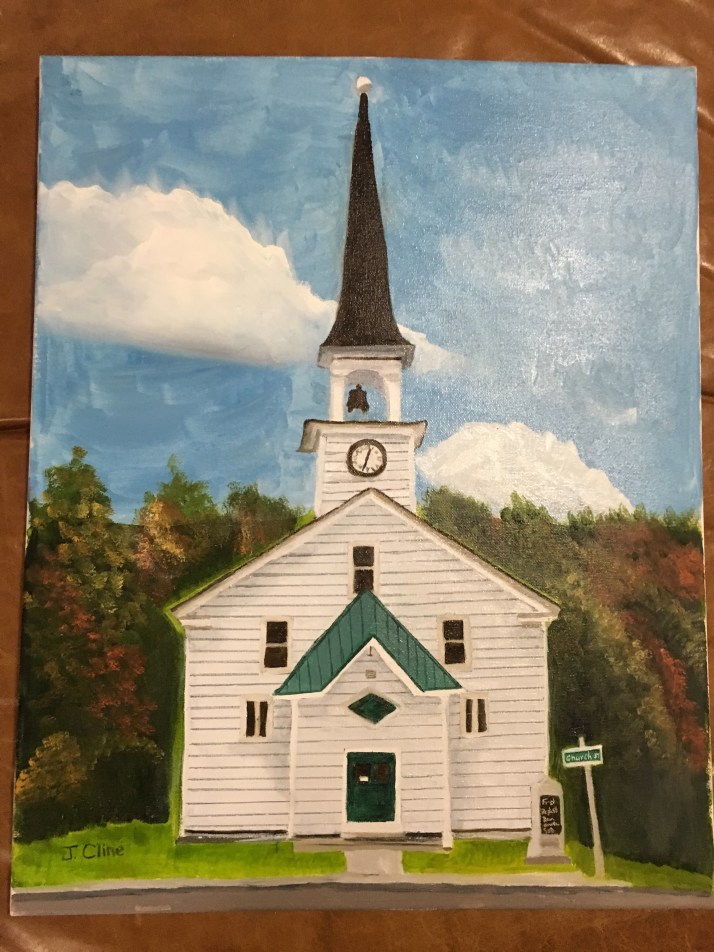
As I shared before, I am learning to paint as a member of the Artists on Main Painting Society in Goodlettsville. Here’s my third effort. It is a church that Wanda Diatikar and I saw this past October in Woodstock, Vermont (thanks Linda Coombs for the recommendation).

Chaplain’s Corner – Advent (Promise)

There’s a lot not to like about December. It’s cold. It’s often wet. It’s often wet and cold. It can be dreary. The days are getting shorter, and the traffic seems to get worse. But over the years, I have learned to love December for many reasons. Here are a few:

  1. As much as I love to garden and see things grow, December affords me some time to clean out my gardens and to rest along with the ground.
  2. I try to appreciate the cold crisp air, contrasting it with the hot and humid days of summer when I was wishing for a break in the heat.
  3. With the leaves off the trees, I can see through the trees into people’s back yards and even further. I can see through the trees into the fields beyond as I am driving along the interstate. I know that sounds weird (please don’t judge me), but it’s just fun to see what is usually hidden by the trees and other undergrowth of spring, summer, and fall. And you are more likely to see hawks and other similar types of birds when the leaves are off the trees.
  4. I love homemade soup, chili, and other hearty meals. They are just better when it’s cold outside.
  5. I love “cozy.” Cozy is just a wintertime thing and it’s so comforting.

I think that December is also a great month because of Christmas, of course, and because I know that the New Year is right around the corner, with its promise of new beginnings.

Maybe promise is the best reason of all to love December, because December is a month of resting on God’s promises.

  • We know that December won’t last forever, that spring will always follow winter. “As long as the earth endures, seedtime and harvest, cold and heat, summer and winter, day and night will never cease” (Genesis 8:22).
  • We know that light followed darkness. “…the people living in darkness have seen a great light; on those living in the land of the shadow of death a light has dawned” (Matthew 4:16).
  • We know that eternal life is promised to all who believe. “For God so loved the world that he gave his one and only Son, that whoever believes in him shall not perish but have eternal life” (John 3:16).

The Season of Advent began this past Sunday. It runs from the fourth Sunday before Christmas through Christmas Eve. During Advent, we plan and prepare for the second coming of Christ just as those in Jesus’ day anticipated the first coming of Christ. Let us celebrate the fact that we can both look back on how God fulfilled his promise beginning in Genesis 3:15 with the birth, life, death, and resurrection of Christ, as well as look forward to living each day in community with the risen Lord and our fellow believers.

In Christ,

Judy