Archive | January 2019

Chaplain’s Corner – Love is Kind

Love is patient, love is kind”  1 Corinthians 13:4 (NIV).

Last week we talked about how the action of patience or longsuffering demonstrates love; patience is not passively waiting. Likewise, demonstrating kindness is love in action. Like patience and love, kindness is also listed as an attribute of the fruit of the spirit. That means that it can only be properly exercised through the power of the Holy Spirit.

Paul tells us that God, in his infinite love and mercy, will raise us up to sit with Jesus in the heavenly places “so that in the coming ages he might show the immeasurable riches of his grace in kindness toward us in Christ Jesus” Ephesians 2:7. And Paul instructs the Ephesian church to Be kind to one another, tenderhearted, forgiving one another, as God in Christ forgave you” (Ephesians 4:32).

I love how the Bible often instructs us to replace one behavior with another; this is really the best recipe for making long-lasting change. It’s just hard to stop behaving a certain way without knowing what to do in its place. For example, in 2 Timothy 2:24, we are told that “…the Lord’s servant must not be quarrelsome but kind to everyone.” So the instruction is to bestow blessings and generosity and graciousness, even when you feel you want to start or continue an argument over something. For example, we can be kind even when we are giving directions. Rather than saying “that’s not right” or “you can’t do that,” instead say “let me show you” or “here’s the way we do this here.” That comes across helpful or kind rather than argumentative or hostile. I must also note that our nonverbal communication is equally important in the showing of either kindness or rudeness.

In reading these passages, I then begin to equate kindness with grace, tenderness, forgiveness, and not being quarrelsome. In many ways, kindness can be thought of as courtesy, civility, and graciousness. Some adjectives used to describe “kind” behaviors according to the Merriam-Webster Dictionary are sympathetic, helpful, forbearing, gentle, giving pleasure or relief, affectionate, and loving. Kindness is not just saying flattering things. Kindness is genuinely considering the other person’s well-being and taking action accordingly.

Two of the Mission’s Core Values are directly aligned with kindness: Radical Hospitality and Culture of Honor.  Four of the tenets of the Mission’s Code of Conduct also include elements of kindness: Communication, Confidentiality, Compassion, and Servanthood.

When we are kind to one another, we are displaying Christ-like love. We must be empowered, because in truth, we don’t always feel like being kind. Sometimes we are tired, in a hurry, or preoccupied. It’s really difficult to be kind to someone who has not been kind to us. But Jesus doesn’t give us any excuses for failure to be kind. In fact, he tells us to turn the other cheek, and go the extra mile (Matt 5:38-42).

Hopefully, we all have at least one role model we would think of when we think of these attributes. My mother was extolled for her kindness. She always had a smile and expressed concern for others. She was always gracious in her conversation, and she was genuine. It not only gives me pleasure to hear others praise her in this way, it also inspires me. I pray that you and I will be that role model for others.

In Christ,

Judy
Chaplain’s Corner – Love is Patient

Love is patient, love is kind” 1 Corinthians 13:4 (NIV).

Last week we began a series of devotions about love from 1 Corinthians 13. The scriptures tell us on more than one occasion that the greatest commandment is to love God and the second is to love each other. In 1 Corinthians 13 Paul tells us that the greatest of the spiritual gifts is love. But what is love really? How do we really love God and each other in the way that most emulates God’s love for us?

Starting in 1 Corinthians 13:4, Paul begins to enumerate the ways that we demonstrate love, starting with patience.  Another translation for patience is longsuffering.  Why did Paul have to put this characteristic first? Maybe so that we would be patient enough to suffer through all the other descriptions of love? I don’t know. I do know, though, that this one is challenging.

What are some of the situations that come to mind when you think of being patient?

  1. Waiting in line; waiting in traffic
  2. Waiting for someone to answer your call (as in, your estimated wait time is 52 minutes).
  3. Waiting for a raise or promotion; waiting for results from the doctor.
  4. Listening to someone who is longwinded, especially when the subject is not close to your heart, or worse, when you have heard it all before.
  5. Letting a child or someone you are teaching do whatever the thing is themselves, like work a math problem or tie their shoes, etc.
  6. Enduring a long illness, either yours or someone you care about.
  7. Enduring a season of misfortune, when it seems that nothing is going your way.
  8. Enduring a time of imprisonment.
  9. Enduring a time when you believe you have been treated unfairly.
  10. Enduring a time when others should be taking action and it appears that they are not.

What do we tend to do when we are waiting?

  1. Worry?
  2. Complain?
  3. Express displeasure, sarcasm, or rage?
  4. Try to take matters into our own hands?
  5. Entertain feelings of hopelessness and despair?
  6. Give up?

What does any of this have to do with love? Well, obviously none of these reactions have anything to do with love. These reactions reflect self-centeredness at best and lack of trust in God at worst. They are not a testimony of faith in Christ and putting God first, and they harm rather than help those around us.

These situations are typically visible to others, so our reactions may also be visible to others. The situations outlined above, and those like them, are actually opportunities to demonstrate our love of Christ, our trust in His infinite mercies. If we love others more than ourselves, we will actively care more about the impact we are having on those around us than on what the situation is doing to us, so we will use the experience to testify to the all-encompassing love of God. That is, we change our perspective away from our own needs and selfish desires, and we actively and productively and lovingly wait.

Here’s a scenario: You stopped at the grocery store on your way home from a long day at work. You are tired, and you have people at home waiting on you for dinner which you have to cook when you get home. There are only two checkout lines and both are very long.

  1. Reaction #1: You are mad because why didn’t some other responsible adult in your house go the store instead of you, so you tell everyone around you. You complain about the store, the service, your family. You tell everyone how tired you are. Or maybe you don’t verbalize anything, but you just stand there and feel sorry for yourself or dwell on how bad your feet hurt. When you finally get to the cashier, you let them have it (especially when they stop to chat with the bagger about how long it’s been since their last break when they should be ringing up your groceries (no, this has never happened to me). When you get home, you also tell everyone in your family about your horrible experience.

Result: You don’t feel any better. No one around you feels any better. That hour you just spent at the grocery shopping and in line is a wasted hour of your life. No one is any better off.

 Reaction #2: While standing in line, you thank God that you have money to buy groceries and a place nearby to shop and that they had what you are looking for. You say a prayer for the grocery employees. You look around at the others standing in line. Perhaps someone behind you looks more tired than you, so you swap places with them. You say a silent prayer for those around you for whatever they may be dealing with, because why else would anyone be in line at this time of day who didn’t have to. You strike up a conversation with those around you, trying to ease the time, make a friend, show concern or compassion. You greet the cashier and bagger with a smile and thank them for their help. When you get home, express joy at seeing everyone and ask about their day.

Result: You probably feel better than you would have. You have made a positive impact and maybe even given hope and encouragement to someone. You have lifted the spirits of the staff.

Being actively patient didn’t take any more time or any more energy, but the people around you have benefited from your presence and God has been glorified by your prayers. This is selfless love of others.

One more thing: in the list of situations above, some are more life-altering than others. Waiting in line for groceries is trivial compared to enduring an illness and/or long recovery period. However, every time of waiting is practice. We use the lesser situations to practice and prepare for the greater situations in life. Practice patience.

The Apostle Paul writes in 1 Timothy 1:13, 16: “Even though I was once a blasphemer and a persecutor and a violent man, I was shown mercy because I acted in ignorance and unbelief….But for that very reason I was shown mercy so that in me, the worst of sinners, Christ Jesus might display his immense patience as an example for those who would believe in him and receive eternal life.”

In Christ,

Judy

Chaplain’s Corner – The Greatest of These Is Love

So now faith, hope, and love abide, these three; but the greatest of these is love” (1 Corinthians 13:13 (ESV).

When Jesus says that the greatest commandment is to love God and love others, that gets my attention. When the apostle Paul says that of faith, hope, and love, the greatest of these is love, that gets my attention. The thirteenth chapter of 1 Corinthians is called the “love chapter.”  It was my Grandma’s favorite passage so I have read it for years. It is even more powerful when you realize the context. Paul has just written a powerful explanation of the spiritual gifts in the previous chapter, and he talks about how we are the body of Christ. This is all very significant teaching to a believer, but then he goes on to say in verse 1 of Chapter 13, “And now, I will show you THE MOST EXCELLENT WAY” and he begins to tell us of the importance of LOVE.

There’s a saying attributed to Teddy Roosevelt, “Nobody cares how much you know until they know how much you care.” I think this is what Paul is trying to tell us. Every single position here at Nashville Rescue Mission includes the role of influencing someone—guests, program participants, staff, peers, volunteers, managers. Sometimes you can influence through your position; however, that is never long-lasting. We may be able to influence through our knowledge, but that can easily be overturned by someone else with more or different knowledge.  What Teddy and the Apostle Paul are telling us is that when we first love those whom we serve or work alongside or live with, then everything else good is possible. God is love, and God is good, so when we love, we are most like God and have the ability to be and do the most good.

The English language does not do justice to the word “love.” Or maybe it’s just our American culture. We love everything. We love flowers, chocolate, and a good book (or at least I do). We love the Titans and the Predators (at least when they win). However, you can see that this term implies more of a feeling.  More accurately, love is an action, not a feeling.  The Greek language has at least four words for “love:” Eros (sexual love), philia (brotherly love and affection), storge (family love), and agape love. Agape love is the type of love that is described in 1 Corinthians, and is sometimes translated “charity.” It is a “self-giving love that loves without demanding or expecting repayment. It is a love so great that it can be given to the unlovable or unappealing. It gives because it loves; it does not love in order to receive. It has much to do with self-denial for the sake of another.” It’s easy to love chocolate; it’s not so easy to show agape love. Agape love is a spiritual love that we cannot have unless we have the Holy Spirit. Agape love is the supreme fruit of the Holy Spirit. Agape love is the love that Jesus displayed toward each of us.*

One big difference between gifts (plural) of the spirit and fruit (singular) of the spirit is this:

  1. Every believer has at least one of the gifts of the spirit (1 Corinthians 12:7-11).
  2. All believers possess all the dimensions of the fruit of the spirit: love, joy, peace, forbearance, kindness, goodness, faithfulness, gentleness and self-control (Galatians 5:22-23).

Therefore, as a believer, you possess this gift of agape love.  However, as believers, we must intentionally practice this gift and hone it as a skill in order for it to be visible in us by others. I will be using the next few Chaplain’s Corners to write more about this, and I encourage all of us to work hard to manifest agape, or charitable love toward others.

*Words in quotes from this reference: https://www.blueletterbible.org/Comm/guzik_david/StudyGuide2017-1Cr/1Cr-13.cfm

In Christ,

Judy

Chaplain’s Corner – Choices and Inclinations of the Heart

Then Solomon stood before the altar of the Lord in the presence of all the assembly of Israel and spread out his hands toward heaven…. (praying to God) that he may incline our hearts to him, to walk in all his ways and to keep his commandments, his statutes, and his rules, which he commanded our fathers” 1 Kings 8:22, 58 (ESV).

We all make choices every day. Some choices are conscious choices like where we will go out for lunch—McDonalds or Sonic. All other things being equal such as cost or distance, we may use a rational thinking process—which restaurant am I likely to get in and out faster so I will be back to work more quickly; or we may use  preference to choose—am I in the mood for French fries or tater tots? Other choices are subconscious such as the thinking patterns that run through our minds, but they are choices even though we do not consciously think about them that way.

We always make choices based on our inclinations. According to R.C. Sproul, “we always choose according to the strongest inclination, or desire, of the moment.” Sproul goes on to say, “…there are times when my desire to sin is greater than my desire to obey; when that happens, I sin. When my desire to obey is greater than my desire to sin, then at that moment, I refrain from sinning. My choices reveal more clearly and more certainly than anything else the level of my desire.”*

Understanding this is helpful to me as I think through my choices and decision-making each day. Like the Apostle Paul, I don’t always do what I know I should. How can I do better? I believe the key is to pray to the Holy Spirit to incline my heart toward pleasing God, to give me the desire to please him in every decision, whether it is what I think, what I say, or what I do. As a believer, I have the gift of the Holy Spirit as my counselor to help me with these matters, and I believe that praying to the Holy Spirit to incline my heart toward Him is what will allow me to use his power in the way that Jesus intended.

Here’s where the rubber meets the road: if we find ourselves at a point of temptation—to eat/drink/inhale/inject something that we know we should not, or to engage in a sexual activity that we know we should not, or to gossip or malign someone, or to lie, or to fly off the handle, or to tell or listen to something that is not wholesome (you get the idea), it is nearly impossible to make good on- the-spot choices without prior preparation. But if we have genuinely thought and prayed through these temptations in advance, then we are much more likely to make good decisions when the temptations occur, and to take the godly course of action. This isn’t just about not doing what is wrong. It is also about doing what is right.

In addition to praying, we must become informed through diligent Bible study about God and his will. We must keep our eyes on God. We must stay in relationship with Jesus. These disciplines help us to train our desires and inclinations in the right way so that in any moment of decision, our desire and inclination to do what is right is more likely to outweigh our desire to do what is sinful. This works in the most everyday situations, from what and how much I choose to eat and drink, to what I decide to watch on TV, to how I think about my supervisor or my coworker, to what I say about my supervisor or coworker. And of course it applies in greater decisions such as who I will marry, how I will raise my children, etc.

One other thing: as I mentioned before, as hard as we try we will still fail sometimes. So how does God view our failures? This is even more complicated because we observe that some people who are not believers seem to be so good and demonstrate successful decision making, while those we know to be believers seem to make bad decisions. This is where our motivation, the true desire of our heart, comes into play. We know that even when we desire to do good, sometimes we fail, just like the Apostle Paul. But when God is evaluating us, he is taking into account our motivation, our desires. So this means that believers who genuinely desire and make every effort to please God will please God even in their failures; and those who are not believers, no matter how “good” they are, will not be able to please God. As 1 Samuel 16:7a (ESV) puts it:  “For the Lord sees not as man sees: man looks on the outward appearance, but the Lord looks on the heart.”

The subject of the Chaplain’s Corner last week was “Resolutions,” which are typically big long-term goals. In order to be more successful with our resolutions we need to make the best daily choices, therefore:

  1. If you have not already, invite Jesus into your heart.
  2. Pray to the Holy Spirit to help you to change the desires of your heart; to incline your heart toward the things of God.
  3. Strengthen your practices of prayer, bible study, and meditation on the Scriptures.
  4. Be conscious that everything you think, do, and say is a choice and pray to make the godly choice.
  5. At the end of each day, evaluate how you did, repent of the bad decisions, and resolve to do better the next day, with the ongoing counsel of the Holy Spirit.

*Reference: The Meaning of Man’s Will, by R.C. Sproul

In Christ,

Judy

Painting

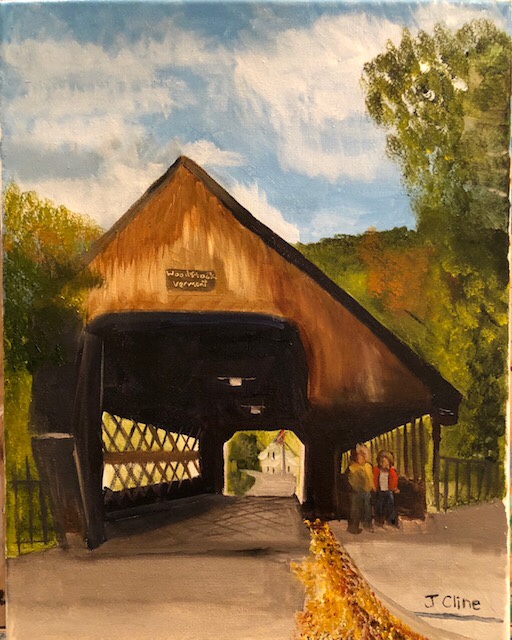
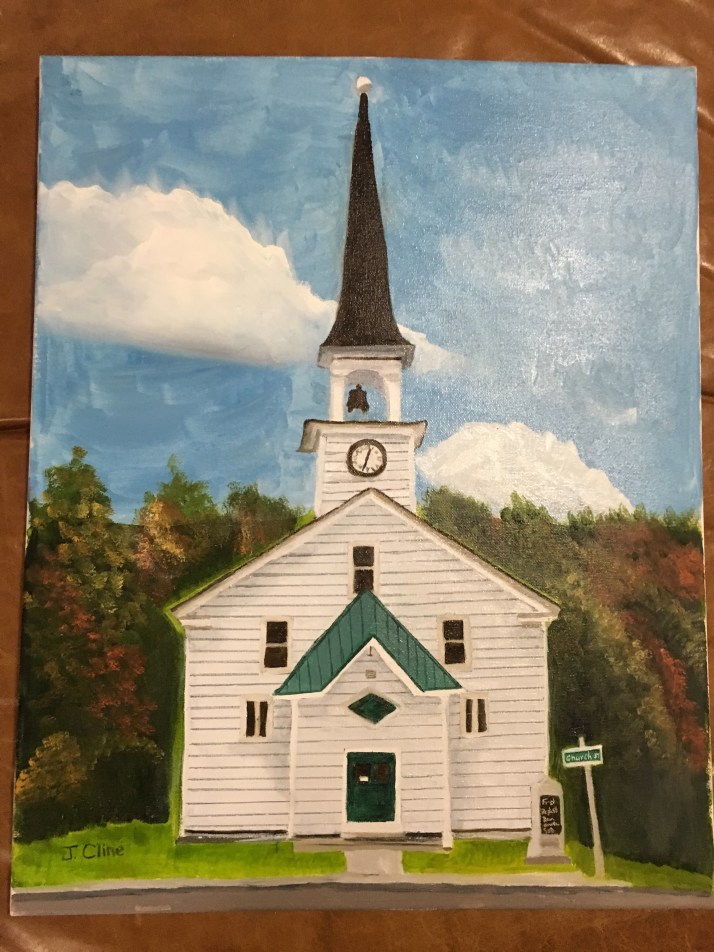
Here are my latest paintings.

The covered bridge is in Woodstock, Vermont. After stopping to take the picture last October, my friend Wanda and I drove through the bridge right out that little road that is depicted there. Thanks to our friend Linda for insisting that we go to Woodstock.

The dog is our first Labrador, Buck. There will never be another like him. I wish I could have done him more justice, but it’s my first one of an animal and only my fifth painting ever. I’ll keep trying.

Chaplain’s Corner – Resolutions

I love to make resolutions for the New Year; however, I’m not so good at keeping them.  For example, I gained 10 pounds last year rather than the 20 I had intended to lose. This was brought home to me this past week as I sat down to think through what I wanted to resolve for 2019. Sadly, I felt that I needed to just try again on the 2018 resolutions and maybe try harder. However, we all know that doesn’t work. I think that is why so many people I know have given up on making resolutions; realistically, why go to the trouble just to feel bad about it at the end of the year.

All that said, I think God is pleased when we are intentional about wanting to make changes for the better. In Lamentations 3:40, God speaks through the prophet Jeremiah: “Let us examine our ways and test them, and let us return to the Lord!” And in the New Testament, Paul says: “Not that I have already obtained this or am already perfect, but I press on to make it my own, because Christ Jesus has made me his own. Brothers, I do not consider that I have made it my own. But one thing I do: forgetting what lies behind and straining forward to what lies ahead, I press on toward the goal for the prize of the upward call of God in Christ Jesus. Let those of us who are mature think this way, and if in anything you think otherwise, God will reveal that also to you” (Philippians 3:12-15).

So yes, I think that resolving to become more like Jesus is a worthy goal. However, it generally takes more than just resolving. To really make changes in our behaviors, we need to change our hearts and minds. Changing our hearts involves the deepest part of our being, and requires the help of the Holy Spirit. It also means that our goals must be in alignment with God’s will. “Therefore, I urge you, brothers and sisters, in view of God’s mercy, to offer your bodies as a living sacrifice, holy and pleasing to God—this is your true and proper worship. Do not conform to the pattern of this world, but be transformed by the renewing of your mind. Then you will be able to test and approve what God’s will is—his good, pleasing and perfect will.” Romans 12:1-2.

Here are some great verses that I am praying over as my resolutions for 2019:

Live 10:27 – “He (Jesus) answered, “‘Love the Lord your God with all your heart and with all your soul and with all your strength and with all your mind’; and, ‘Love your neighbor as yourself.’” Taking my cue from the Parable of the Good Samaritan, I resolve to pray for and be more intentional about actually showing love to anyone In my path who needs help, whether friend, family, coworker, stranger, or actual neighbor. One of the tools I have found to help me pray for the people who live nearby by name is a website, BlessEveryHome. So many of you are role models for me because when you hear or see a need, you take action immediately. You really encourage me in this area.

Hebrews 12:1 – Therefore, since we are surrounded by such a great cloud of witnesses, let us throw off everything that hinders and the sin that so easily entangles. And let us run with perseverance the race marked out for us….” We are hearing lots of discussion about decluttering. Having lived in my house for more than 40 years, I am in serious need of getting rid of stuff. I spend way too much time making room, moving stuff around, cleaning stuff, fixing stuff. Realizing that dealing with excess stuff is getting in the way of time for ministry, I believe I will be more motivated to actually follow through. And I’m sure my kids will appreciate it, too (one day). Stuff is not the only thing that I need to get rid of. I also need to shed myself of any activities or habits that are not wholesome or do not lead to building up myself and those around me. And I need to be sure that every day I confess and repent of sins that otherwise will prevent me from running the race that God has marked out for me.

1 Corinthians 3:16 – “Don’t you know that you yourselves are God’s temple and that God’s Spirit dwells in your midst?” I believe this verse applies to my entire being, and that I must treat my entire being—body and mind (heart)—with reverence. That means taking care of what I put into my body and mind, and properly exercising my body and mind. I want to be the best self I can be so that I can serve God as effectively as possible.

I believe that praying over these verses and using them for guidance will keep me aligned with God’s will; and along with praying for strength and endurance from the Holy Spirit, I believe that I will have the power to accomplish these things.

As we do life together here at the Mission, I challenge us to encourage each other and hold each other accountable as we seek to “press on toward the goal for the prize of the upward call of God in Christ Jesus.”

In Christ,

Judy